

Digital boundaries for couples turn assumptions into specific agreements. Permission to borrow a phone for directions is different from permission to read messages, open accounts or share photographs.
Talk about what is shared, for what purpose and how either person can revise the agreement. Closeness can include privacy. If monitoring, threats or control make changes risky, seek private technology-safety support before altering accounts or access.
Make permission specific
Read the guide as text
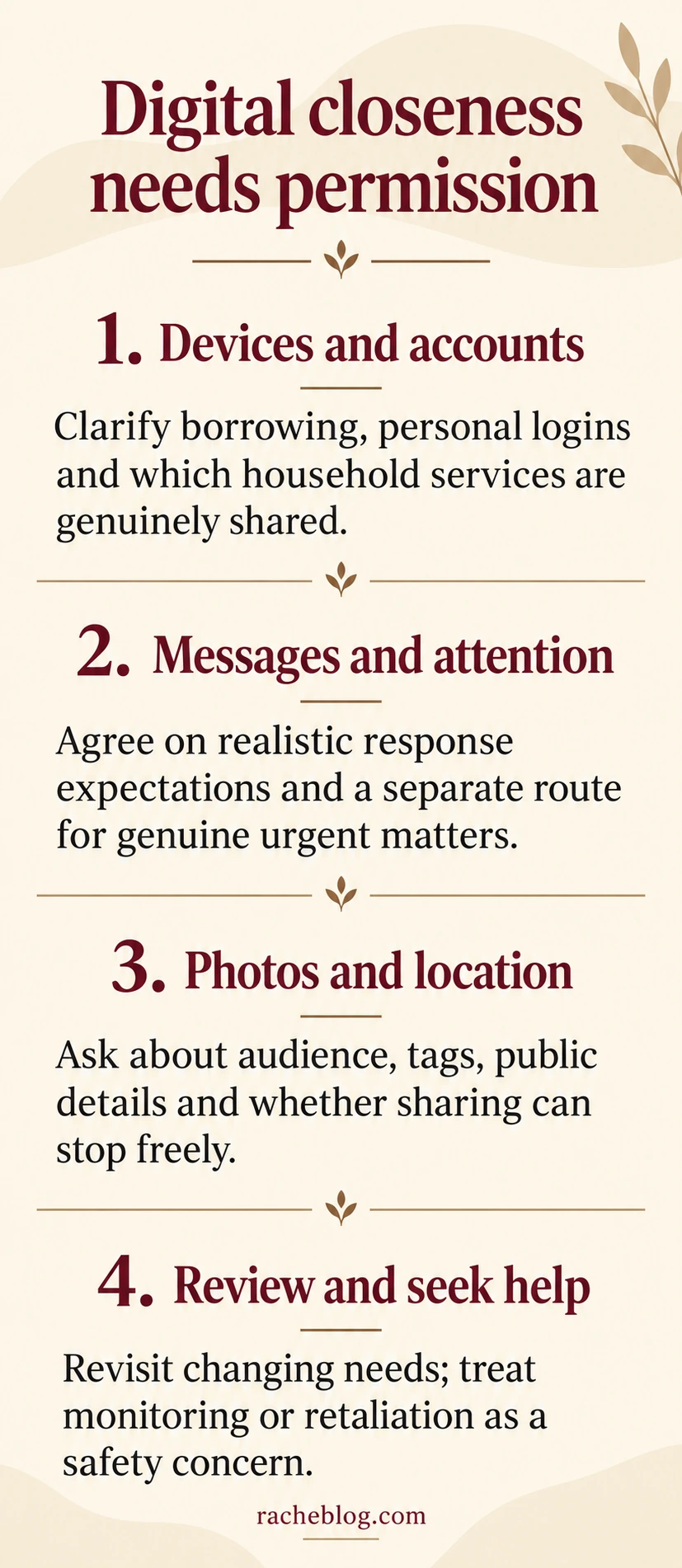
- Devices and accounts. Clarify borrowing, personal logins and which household services are genuinely shared.
- Messages and attention. Agree on realistic response expectations and a separate route for genuine urgent matters.
- Photos and location. Ask about audience, tags, public details and whether sharing can stop freely.
- Review and seek help. Revisit changing needs; treat monitoring or retaliation as a safety concern.
Closeness Doesn’t Mean Access
Ask what sharing a device means to you. Permission to use a phone for a map doesn't mean that it includes reading messages, looking at pictures, or opening a bank account.
An agreement can state the purpose, and you can allow them to use your phone to call a restaurant while asking them to seek permission before opening anything else. This protects both people from relying on different assumptions.
Love is respect discusses setting boundaries around what each person freely chooses. The important feature is a conversation about what each person freely chooses.
Don't treat access as a test of loyalty. Don't tell someone, "If they have nothing to hide, they can give you their phone," because this takes away the request and makes it feel pressuring. You can talk about your concerns about honesty without thinking that access to the device is the only true answer.
Keep Personal Accounts Private
Decide which accounts are your own and which you want to share, such as emails, financial services, health portals, and work systems.
A password can create more access than you expect, especially when the same account connects to backups, calendars, pictures, or password resets. Do not assume that sharing one login just affects one app.
If you use household services, think of a shared access feature instead of exchanging every personal password. Product options change, so check the services' official guidance and terms.
You don't have to prove independence by refusing help. The question is whether the help allows you to stay in control and fit your purpose. A partner can help with a task while you stay present but still keep your details private.
Agreeing on a Response Time
A delayed reply can mean that someone's driving, sleeping, caregiving, or just being away from their phone, and it doesn't automatically mean that the relationship is failing. Talk about what you expect, such as saying you can't reply during work, but you'll check messages afterward.
Having conversations from regular messages to urgent ones is important in deciding how urgent matters should be talked about. Don't create an emergency channel that's used for regular situations.
Read receipts, online status, and typing indicators can create misleading ideas about attention. A person might open a message without being able to answer it right away. You can change these features when it's safe and available, but the relationship conversation matters more than the setting on your phone. The purpose is to set expectations that leave room for both people to live their everyday lives.
Making Screen-Free Time
You might decide you want to have meals, conversations, or part of the evening without your phone. Talk about the connection you want instead of treating the phone as disrespectful in every situation.
Ask your partner if you could have 20 minutes after dinner without being on the phone so you can talk about important things, such as work, responsibilities, accessibility, or urgent contact.
The arrangement should work fairly, and one person's messages don't matter more. One partner shouldn't be the one who has to always enforce it. You can ask if the time works for both people. A partner who uses their device for communication, symptom management, or other access might need a different plan. The purpose is to give attention to the relationship, not to put each device away if it's needed in someone's life.
Decide What You're Comfortable Sharing About Your Location
Some couples enjoy sharing their locations because it makes every day plans easier or helps them feel safer. Others prefer to keep that information private, and there's nothing wrong with either choice. Just because someone doesn't want to share their location doesn't automatically mean they're hiding something or that they don't care about their relationship.
Before turning on location sharing, talk about why you want to use it and what you're both comfortable with. Think about who will be able to see the information, when it will be used, and whether either person can turn it off whenever they want. For example, sharing your location while traveling somewhere unfamiliar is different from having someone constantly monitor where you go and question every stop you make.

It's also important to remember that agreeing to share your location shouldn't turn into an expectation that you have to explain every movement throughout your day. Location apps aren't always completely accurate, either. Just because a map shows someone in a certain place doesn't mean it tells the whole story about what they were doing or why they were there.
But if you're afraid of how your partner might react when you turn off location sharing, the problem could involve controlling behavior rather than an ordinary disagreement about privacy. In that situation, it's important to think about your safety before making sudden changes just to see how your partner responds.
Talking privately with someone who understands technology-related abuse might help you figure out what to do next. If possible, use a device or communication method that your partner can't monitor. The important thing is remembering that sharing your location should be a personal choice, not something you're forced to do to prove your love or loyalty.
Respect Each Other's Privacy on Social Media
Just because your partner appears in a photograph doesn't automatically mean they're comfortable having it posted on social media. Before sharing pictures or personal details about your relationship, it's a good idea to ask whether they're okay with other people seeing them. Think about who's going to see the post, whether you're tagging anyone, and what information you're including in the caption.
For example, your partner might love having pictures taken together during a vacation but feel uncomfortable sharing details about where they work, their health, or private things happening in your relationship. They might also prefer to keep certain relationship milestones between the two of you. Just because someone agrees to one photograph being posted doesn't mean they're giving permission for every picture or personal detail to be shared in the future.
You don't have to turn this into a complicated conversation. Sometimes asking something as simple as, "Are you okay with me posting this picture on Facebook?" is enough. If your partner says no, try to respect their decision instead of assuming they're embarrassed by you or trying to hide your relationship.
It's also important to talk about what happens if someone changes their mind after a picture has already been posted. Maybe they're no longer comfortable with the photograph being public, or something has changed that makes them more concerned about their privacy. Even though deleting a post doesn't guarantee that every copy will disappear from the internet, taking their concerns seriously still matters.
Remember that once something is shared online, you can't always control where it ends up or who saves it. That's why talking about what you're both comfortable sharing ahead of time can prevent misunderstandings.
The goal is to enjoy sharing parts of your relationship without making either person feel like they're losing control over their personal information. Respecting each other's privacy is one more way to build trust and show that both people's feelings matter.
Talk About Intimacy Alone
Consent to receive or send an intimate image does not include permission to show it to others, forward it or upload it. Talk about what each person is comfortable with, including storage and deletion.
No one owes an intimate image because they get one or because a partner says it could prove trust. Pressure, threats, and guilt don't work with the exchange. Don't upload intimate materials to an editing app, chatbot, or other services without knowing the consequences and getting the right kind of consent. A private tool might still hold the information under its policies.
If intimate material is shared or threatened without consent, get appropriate and legal support. Do not assume that you have to negotiate with the person making the threats. Laws and reporting options are different, and a knowledgeable service can help you understand your choices.
Protecting Other People’s Information
Your phone can have a friend's private disclosures, a client's information, or a child's personal details. You might not want to share all of these things, even if you want to reassure your partner. Explain why you're limiting it without avoiding every question. You can tell them that you'll talk about the concern, but that you're not going to open your friend's private messages. Setting a clear boundary is something that doesn't need to be changed.
When it comes to children, consider privacy, safety, age, and their views before you post information. Don't share publicly school information, embarrassing moments, health details, or family conflict just because it feels relatable.
A couple's agreement doesn't give consent on behalf of every person whose data appears in the account. Third-party privacy is a good reason to keep your information limited and doesn't mean that the relationship lacks closeness.
Know When and How to Ask for Outside Support
Sometimes when you're having problems in your relationship, it helps to talk to someone outside of it. Friends, family members, therapists, online communities, and even AI tools can offer different kinds of support. But it's important to think about what information you're comfortable sharing and how to respect each other's privacy. You should never feel like you need your partner's permission to seek confidential professional advice or talk to someone you trust when you need help.
There's also a difference between privately talking about your own experiences and sharing personal conversations online for strangers to judge. Before posting messages or discussing relationship problems in a public forum, think about whether the information could identify your partner or other people involved. You can explain what you're going through without sharing every personal detail.
If you're using an AI tool to get relationship advice, be careful about uploading private messages, financial information, medical records, or personal details about children. It's important to understand how the service handles information and whether sharing someone else's private details is appropriate. Also, remember that AI-generated advice isn't always accurate and can't tell you exactly what your partner is thinking or feeling based on a conversation you've shared.
But respecting privacy doesn't mean you should have to keep everything about your relationship a secret. If your partner insists that you can't talk to anyone about what's happening, especially when you're feeling hurt, controlled, or unsafe, that can be a warning sign. There's a difference between wanting to keep personal matters private and trying to prevent someone from getting support.
The important thing is finding a balance between respecting your relationship's privacy and making sure you still have people you can turn to for guidance, reassurance, and help when you need it.
Make Sure You Both Understand Your Shared Technology
Technology has become part of everyday life, and many couples share things like security cameras, smart speakers, televisions, calendars, online accounts, and cloud storage. While these devices and services can make life easier, they can also create disagreements when one person doesn't understand what information is being collected or who has access to it.
That's why it's a good idea to talk about how your shared technology works and who is responsible for managing it. For example, you might want to know whether a security camera records continuously, where the recordings are stored, and who receives notifications when something happens. You should also think about how these devices might affect guests, family members, or anyone else spending time in your home.
You don't have to be an expert in technology to ask questions about privacy. Before adding a new device or service, talk about why you want it and whether both people are comfortable with it. Having a camera near your front door for security is different from placing one somewhere that records private conversations or personal activities inside your home.
It's also important that both partners have a fair understanding of the technology they share. One person shouldn't be able to use control over important household devices, accounts, or services as a way to punish, monitor, or control the other. Keeping basic information about shared accounts and services organized can help prevent misunderstandings and make everyday responsibilities easier.
But if your relationship involves abuse, threats, or controlling behavior, be careful about making changes to shared accounts or devices without considering your safety. Changing passwords, removing access, or keeping notes somewhere your partner can find them could create more problems. In these situations, talking privately with a professional who understands technology-related abuse might help you figure out what steps are safest.
The goal is to make technology something that helps your everyday life instead of creating more stress or concerns about privacy. When both people understand how shared devices work and respect each other's boundaries, it's easier to build trust and avoid unnecessary disagreements.
Notice Safety Issues
Knowledge of private conversations, a demand for proof of location, or threats over a password are serious concerns. Unusual device behavior alone cannot confirm monitoring, and a device that appears normal does not rule it out.
The Federal Trade Commission provides information about stalkerware and safety planning. It warns that removing monitoring tools or cutting access can alert an abusive person and potentially escalate harm.
If you think your partner is monitoring you, contact the domestic abuse hotline or a technology safety specialist to help look at your device. Don't just rely on your own browsing or deleting history as a safety solution.
You don't have to confront your partner or get perfect proof before you ask for help. Support can help you look at the risk, hold on to relevant information, and decide what changes fit your situation best.
Example Agreement with Limits
For an illustrative example, imagine Casey and Morgan borrowing each other's phones for navigation. After Morgan opens a message while finding an address, they realize that they have different assumptions about permission.
They agree to ask before they open anything beyond the navigation app. They also talk about public pictures before they decide to check or tag locations or post family updates. For regular messages, they clarify that neither expects a reply if they're driving or in meetings. If something is extremely important, they use the right methods that fit their responsibilities.
This agreement doesn't mean they have the same preferences. This makes the permission specific and leaves room to come back to it later. A good digital boundary is understandable in a regular moment, rather than being a broad statement that sounds respectful but doesn't give guidance when a phone is handed over.
Setting Boundaries
A new job, a shared home, a child, illness, or a change might alter privacy needs. Look at the arrangements again instead of just thinking that old permissions stay the same forever.
Ask what's working, what's uncomfortable, and what changes are needed. A change in boundary doesn't mean that the first boundary was deceptive, but it can show a new risk, responsibility, or preference.
If an agreement is broken, talk about the action and its effect when safe. An apology matters more if it's followed by changed behavior and respect for the limits. Digital boundaries need to support the connection but allow the person to be an individual.
Start with one kind of information, one type of device, and then a recurring disagreement. Make the permission clear and keep consent open to be reviewed at a later time. Always pay attention to whether the agreement leaves both people informed, respected, and allowed to choose on their own.
Prepare a digital-permission conversation
Choose one area to define a specific permission and how either person can change their mind.
This tool cannot detect monitoring. Private specialist guidance may be safer than a joint discussion when there is fear or coercion.
Use the questions and examples in the article above; the draft builder needs JavaScript.
15 questions readers ask
1. What are digital boundaries for couples?
They are agreements about devices, accounts, messages, photos and other information. Useful boundaries are specific, voluntary and open to review.
2. Does borrowing a phone permit reading messages?
No. Permission for one task should not be assumed to include access to other apps, conversations or accounts.
3. Should couples exchange every password?
There is no universal requirement. Discuss purpose and risk; personal, work, medical and third-party information may need separate protection.
4. Is wanting privacy evidence of cheating?
No. Privacy does not prove deception, and access does not guarantee honesty. Look at behavior and discuss the actual concern.
5. How can we share household services?
Check whether the service offers appropriate shared access. Understand what the feature exposes and follow current official guidance and terms.
6. Do delayed replies mean rejection?
Not necessarily. Work, driving, sleep, care duties and access needs affect availability. Agree on realistic expectations instead of interpreting every delay.
7. Can screen-free time be flexible?
Yes. Discuss the connection you want and account for work, accessibility, healthcare or urgent responsibilities.
8. Is location sharing required for trust?
No. It should be a freely chosen arrangement with a clear purpose and the ability to stop without punishment.
9. Should I ask before posting my partner's photo?
Ask about the image, audience, tags and details. Consent to one post is not blanket permission for future posts.
10. Does deleting a post remove every copy?
No. Screenshots or saved copies may remain. Take requests seriously while recognizing the limits of deletion.
11. Does receiving an intimate image allow forwarding it?
No. Sending or receiving does not include permission for forwarding, public posting or uploading it to another service.
12. What about friends' or clients' messages?
Your relationship agreement cannot supply consent for every person's information on your device. Protect relevant third-party privacy.
13. Can I seek confidential advice without permission?
You can seek appropriate private support. Distinguish confidential help from publishing private conversations for strangers to judge.
14. What if I suspect monitoring?
Seek technology-safety or domestic abuse support through a safer route. Consider risk before removing software, changing passwords or cutting access.
15. When should we revisit digital agreements?
Review them when work, health, family or shared living changes, or when either person is uncomfortable. Earlier permission need not be permanent.