

If “soulmate” expresses what a connection means to you, you can value that belief without using it to settle every question about the relationship. Attraction, intuition and a sense of familiarity can matter to you while leaving practical things to discuss.
There is no checklist that can establish another person’s spiritual role in your life. These seven questions focus on how the relationship works and what you are freely choosing.
On this page

Do our important choices fit together?
Talk about the things that shape everyday life: children, money, where to live, exclusivity, work and the time you want together. You do not have to share every interest or settle your whole future at once.
Pay attention to a difference that would require one person to give up something central to them. A strong connection does not make that difference disappear. Ask whether you can find an arrangement you both choose, rather than assuming that love will eventually change the other person’s preference.
Can we both say no?
Consider what happens when you decline affection, need time alone, disagree about a plan or keep something private. Is your answer accepted, or do you face repeated pressure, guilt, threats or punishment?
A spiritual description of the relationship cannot create permission for physical contact or access to your life. Our guide to consent in an ongoing relationship explains why familiarity and an earlier yes do not settle what someone wants now.
How do we handle differences?
Never arguing does not prove that a connection is shallow, and frequent arguments do not prove passion or depth. Consider whether you can raise a concern, listen and disagree respectfully.
If you pause a difficult conversation, can you agree when to return to it? If an agreement is missed, is it acknowledged? The NHS guide to healthy relationships discusses listening, communication and taking time to speak when people are calmer. Threats or intimidation call for attention to safety, not a better argument technique.
What connects us in ordinary moments?
Physical attraction may be an important part of your relationship. It does not have to prove anything beyond what you both enjoy and choose. Likewise, a less sexual or nonsexual connection is not automatically a lesser relationship.
Ask what you like about being together outside the moments that feel most intense. Can you enjoy a conversation, show interest in each other’s lives or cooperate on an ordinary task? Consider the kind of companionship you actually want rather than a rule about how soulmates are supposed to behave.
Is there room for my life beyond us?
Notice whether you can keep friendships, personal interests, rest and responsibilities beyond the relationship. Closeness can include shared routines and mutual support without requiring every decision to revolve around one person.
If you have been neglecting something important to you, identify one change you would like to make. Ask whether it is an ordinary adjustment you can discuss or whether someone is actively limiting your choices. Needing support does not make you defective, and independence does not require you to handle everything alone.
What am I observing, and what am I hoping for?
Make room for both feelings and facts. “I feel a powerful connection” describes your experience. “We have agreed to build a future together” describes an agreement that needs the other person’s participation.
When you feel drawn to interpret a coincidence or intuition as reassurance, also ask what the person has said and done. If you keep searching for proof that you must stay, consider what concern you are hoping the proof will answer. You can take that concern seriously without dismissing a belief that matters to you.
Would I choose this relationship as it is now?
Imagine setting aside a deadline, the time already invested and the fear of missing a destined person. What would make you want to continue? What would need to change? What answer would you give a friend facing the same practical circumstances?
Doubt does not automatically mean you must leave, and a feeling of certainty does not make every behaviour acceptable. You can ask for time, seek confidential support, discuss a workable change or decide to end the relationship.
You do not have to establish whether someone is “the one” before considering your needs. A meaningful connection still leaves both people free to choose whether and how to continue it.
Read the infographic in text
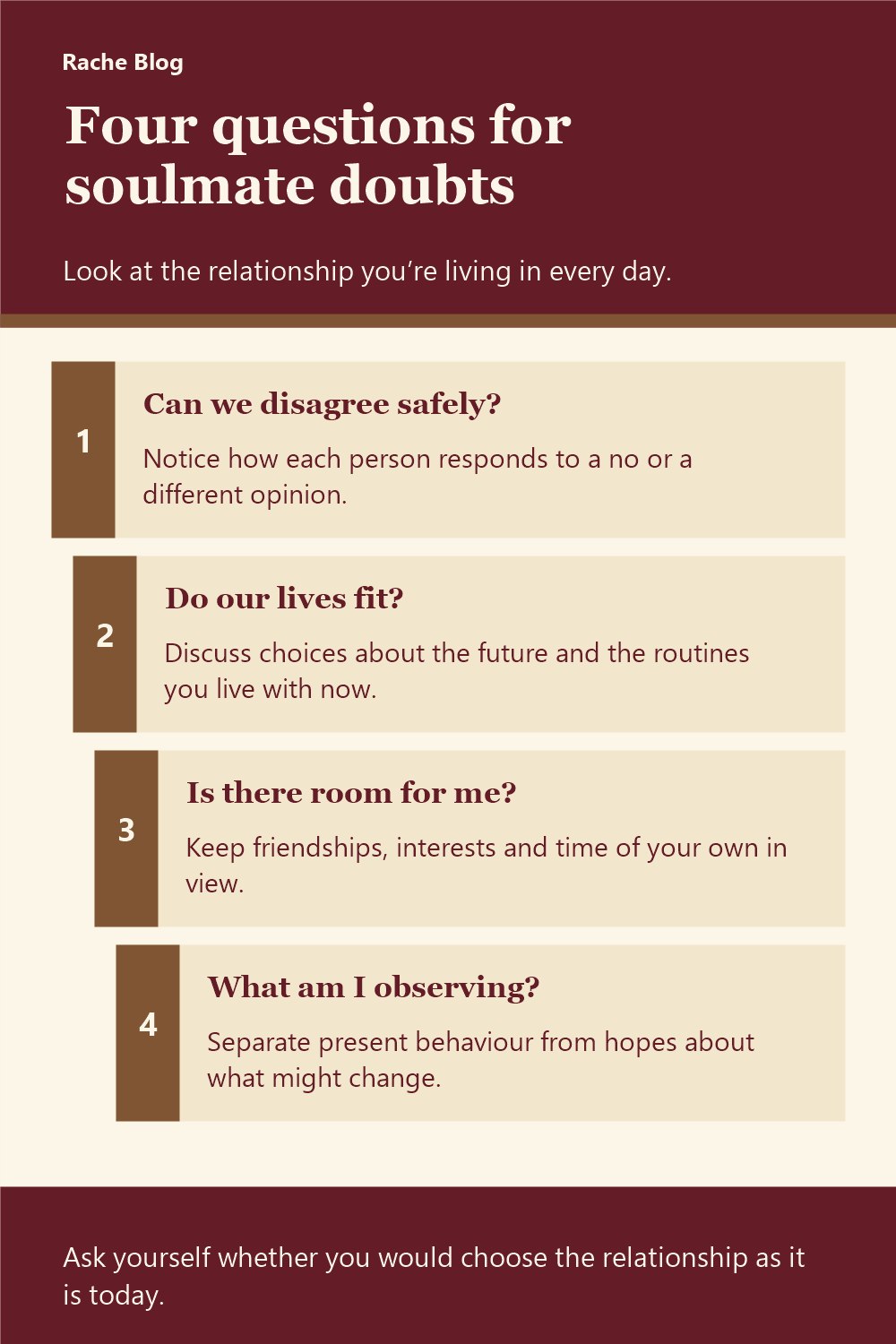
Four questions for soulmate doubts Look at the relationship you’re living in every day.
- Can we disagree safely? Notice how each person responds to a no or a different opinion.
- Do our lives fit? Discuss choices about the future and the routines you live with now.
- Is there room for me? Keep friendships, interests and time of your own in view.
- What am I observing? Separate present behaviour from hopes about what might change.
Ask yourself whether you would choose the relationship as it is today.