

Knowing when to walk away is rarely a matter of finding one perfect sign. You may still care about someone while feeling that the relationship no longer fits your needs or choices.
Start with what is happening now. You can consider patterns, ask for support and think through practical next steps without promising yourself an immediate answer or a guaranteed outcome.
On this page

Name what is making you consider leaving
Try finishing the sentence, “I am considering leaving because…” Be as specific as you can: you want different futures, an agreement keeps being ignored, affection is no longer freely chosen, or you do not want to continue. You do not need to prove that the other person is a villain to acknowledge your preference.
Separate the present situation from the relationship you hope it might become. What has actually been agreed? What has changed? Which concerns have continued despite conversations or attempts to address them?
If the other person has said they do not want a romantic relationship, take that answer seriously. Caring for them does not require you to keep pursuing them or waiting for them to change their mind.
Consider patterns alongside individual moments
One enjoyable evening cannot settle every concern, and one ordinary disagreement does not describe the whole relationship. Consider how you generally treat each other and what happens when a need is inconvenient.
- Can you express a preference or decline a request?
- Are plans and responsibilities discussed fairly?
- When something hurts, is it acknowledged and addressed?
- Can you keep friendships, privacy and interests beyond the relationship?
You do not need to turn these questions into a score. A serious concern about safety or control deserves attention even if other parts of the relationship feel good.
Decide whether a conversation would help
If it is safe and you want to explore continuing, describe a concrete concern and a change you would need. For example: “I have been arranging all our time together, and I am worn out. Would you be willing to share that responsibility?” Ask what the other person wants too.
Notice whether a proposal becomes a workable agreement. A promise is a starting point for discussion, not proof that a pattern has changed. You can decide when to check in again without turning that date into an ultimatum.
You are not required to keep negotiating once you have decided to end a relationship. If you fear threats or retaliation, a joint discussion may not be the right next step.
Give safety its own attention
Threats, intimidation, sexual pressure and control call for more than finding the perfect explanation. If you are worried about how someone may respond to separation, consider confidential support through a device or route that is safe for you to use.
The National Domestic Violence Hotline’s safety-planning information describes planning for people experiencing abuse, preparing to leave or living after separation. An appropriate local service can help you consider your circumstances. In immediate danger, seek emergency help when you can do so safely.
You do not have to confront someone, disclose a plan or announce a date for leaving in order to deserve support.
Think through practical support
Leaving may involve a shared home, money, children, pets, belongings or a social circle. Identify which matters you can handle yourself and where you need qualified local advice or practical help. Do not assume that another person’s preferred arrangement settles your responsibilities or options.
For a situation where ordinary planning is safe, you might begin with one task: ask a trusted friend for a conversation, list the questions you need answered, or find information about a housing arrangement. If keeping notes could expose you to danger, seek safer guidance before creating a record.
You can also think about what contact you want afterwards. Make any necessary practical communication as clear as possible while respecting safety concerns and the other person’s choices.
Allow feelings without making them instructions
You might feel sadness, relief, doubt, affection or several things at once. Missing someone does not by itself decide whether returning would meet your needs. Likewise, feeling relief does not mean the relationship never mattered.
Give yourself room for ordinary routines and people you trust. There is no deadline for feeling ready to date again, forgive someone or tell a polished story about what happened.
Our guide to love, boundaries and accountability explores why caring about someone and choosing to stay together are separate decisions.
Make a private plan around the question that feels hardest
Perhaps you’re unsure how to manage transport or where you would stay. A specific starting point could be asking a trusted person whether they could talk privately, or asking an advocate what support is available locally. If the relationship involves control or threats, prioritize safety when you choose how to reach out.
The U.S. National Domestic Violence Hotline has safety planning guidance. Canada’s family violence support directory lists provincial and territorial services.
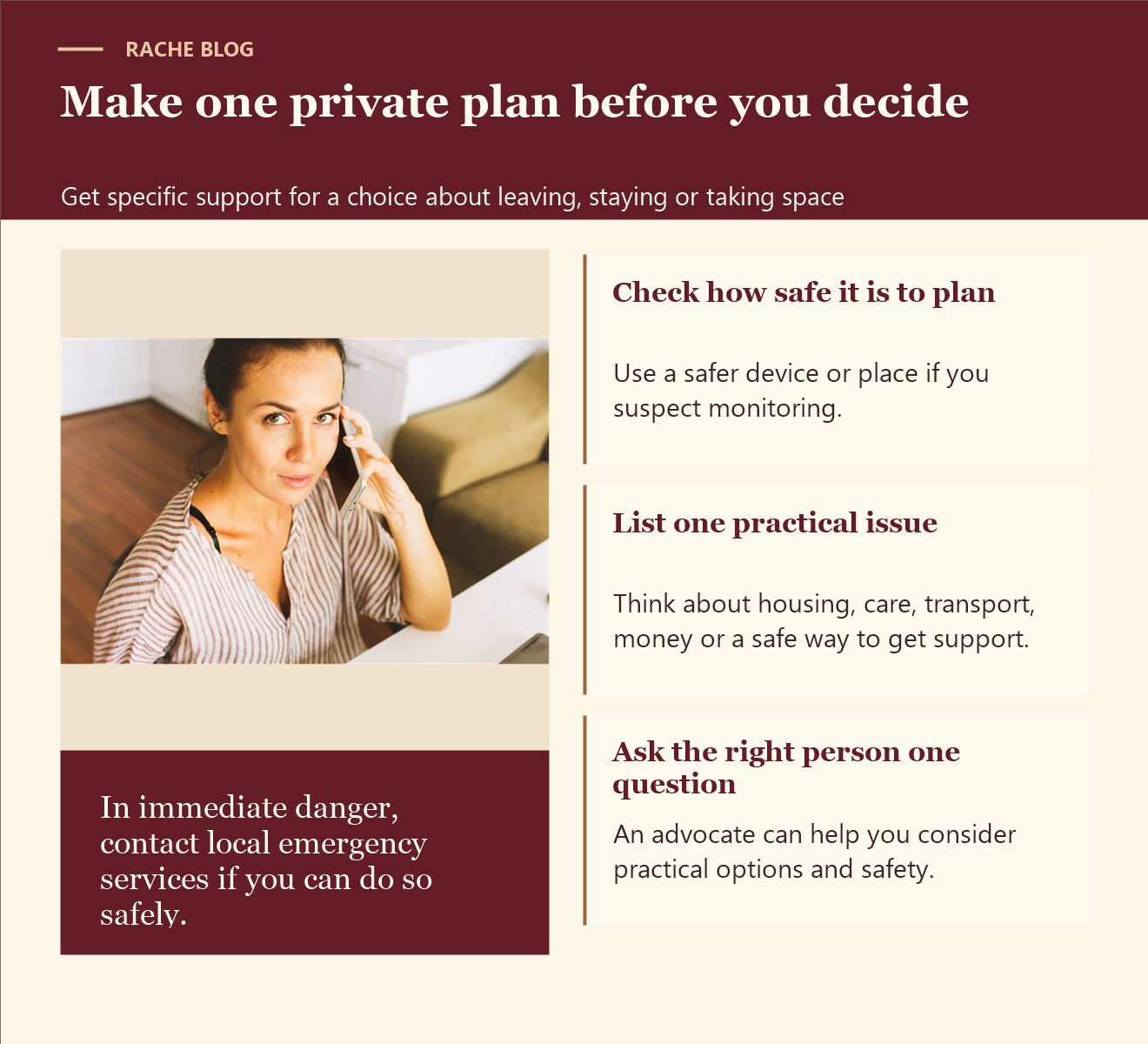
Read the infographic in text
Make one private plan before you decide
Get specific support for a choice about leaving, staying or taking space
- Check how safe it is to plan Use a safer device or place if you suspect monitoring.
- List one practical issue Think about housing, care, transport, money or a safe way to get support.
- Ask the right person one question An advocate can help you consider practical options and safety.
In immediate danger, contact local emergency services if you can do so safely.