

A relationship can feel confusing when affection, plans or expectations seem inconsistent. You may want to know what a partner means, whether an agreement has changed or how much uncertainty you are willing to live with.
Begin with the behaviour and choices you can discuss. A feeling can prompt a useful question without proving what someone else thinks or does. You can seek clarity while respecting both your own limits and the other person’s privacy.
In this guide
1. Name what feels unclear
Start with the particular uncertainty. Are you unsure whether you are exclusive, how often you will meet, what a cancelled plan means or whether a shared decision still stands? “This relationship is confusing” can describe several different problems.
Write down what happened, what you understood the agreement to be and what you want to clarify. For example: “We discussed meeting on Saturday, but I did not know the plan had changed until that afternoon.” That gives you a clearer starting point than deciding that every change must reveal a hidden intention.
You can also ask what you need in order to choose your next step. You do not have to solve every question about the relationship before raising one important concern.

2. Discuss contact and time apart
Wanting time alone does not by itself establish a loss of interest. People differ in their needs for quiet, social time and contact. The practical question is whether both people’s needs and shared responsibilities can fit into a workable arrangement.
You might ask, “When you say you need space, do you mean a quiet evening, fewer messages during work or something different about the relationship?” Then explain what helps you plan your own time. Avoid agreeing to constant availability if that does not work for you.
The NHS guide to relationships and wellbeing suggests listening carefully, asking for clarification and making time for your own interests. Taking space should not mean that only one person is allowed friendships, privacy or a say in the arrangements.
3. Separate a feeling from proof
Your feelings deserve attention. Worry, unease or an intuitive impression may tell you that you want more information, reassurance or a different boundary. They cannot establish whether someone has cheated or explain another person’s private thoughts.
Try separating observation from interpretation. “They checked their phone several times during dinner” describes something you saw. “They must be hiding another relationship” adds an explanation you have not confirmed. Other explanations may be possible, and the interruption can still be worth discussing.
If intuition is meaningful to you, use it as a prompt to reflect and ask questions. You can take discomfort seriously without claiming certainty about its cause or collecting evidence through secret monitoring.
4. Make plans at a workable pace
There is no universal one-year rule for deciding when to share a home, buy furniture or combine expenses. Consider what the decision involves, what you each understand and whether you feel free to decline.
Before making a shared commitment, clarify responsibilities and how you would handle a change of plan. Who owns a purchase? Which costs are shared? What would happen if either person wanted a different arrangement? Seek suitable independent advice when a decision has significant legal or financial consequences.
Slowing down can give you time to understand an agreement. It should not become an indefinite demand that you wait without information. The guide to discussing a serious relationship offers questions about intentions and expectations.
5. Ask clearly while keeping privacy
If it is safe to talk, ask a direct question about the agreement that matters: “Are we both choosing an exclusive relationship?” or “Do you still want to make plans together?” Listen to the answer and notice whether subsequent behaviour matches what was agreed.
A clear conversation does not require access to someone’s phone, passwords or private messages. Love is respect’s guidance on rebuilding trust emphasises that people retain a right to privacy. Marriage does not turn a partner’s accounts or devices into something you can access without consent.
Ask for changes that address the actual issue, such as putting phones away for a meal or communicating a changed plan. Our guide to digital boundaries for couples can help you distinguish practical access from permission to read or share private information.
6. Decide what you need next
You may receive a reassuring answer, learn that you want different things or remain without the clarity you asked for. Consider both the words and the repeated pattern. Are plans becoming clearer? Can you raise concerns without being mocked or punished? Is there room for your preferences as well as theirs?
You can choose to continue with a specific agreement, take space, seek support or end the relationship. You do not need proof of cheating to decide that an arrangement does not meet your needs. Our guide to relationship expectations can help you put those needs into words.
If questions lead to threats, intimidation or fear, prioritise confidential support about safety rather than trying to make the perfect request. A trusted person or appropriate support service can help you consider practical options without requiring your partner’s participation.
For today, choose one question and one boundary you want to understand more clearly. Your next decision can rest on what is available now, rather than a prediction about what the relationship must become.
Decide what a warm message actually changes
Imagine someone sends affectionate messages but has skipped three confirmed plans. You can ask whether they want to make regular time to meet and what schedule they can keep. One affectionate evening can matter alongside what has happened over several weeks.
If a clear answer doesn’t lead to a plan you can rely on, choose how much of your time to make available. If they react with intimidation or pressure when you ask, seek support if you need it.
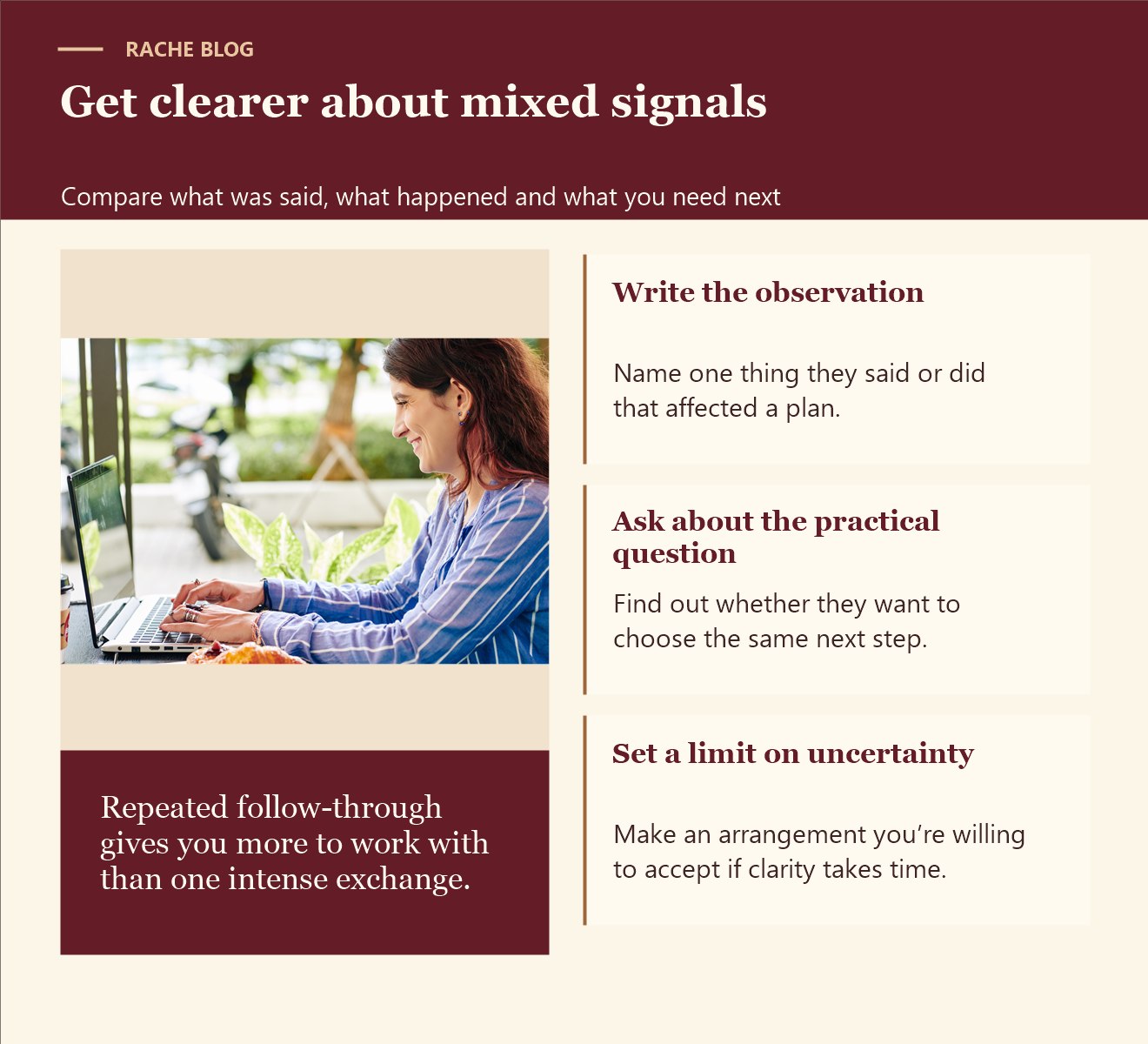
Read the infographic in text
Get clearer about mixed signals
Compare what was said, what happened and what you need next
- Write the observation Name one thing they said or did that affected a plan.
- Ask about the practical question Find out whether they want to choose the same next step.
- Set a limit on uncertainty Make an arrangement you’re willing to accept if clarity takes time.
Repeated follow-through gives you more to work with than one intense exchange.