

When conversations go nowhere or a promising match disappears, it is understandable to wonder whether online dating is worth your time. A disappointing run does not prove that you will never find love online. It does give you a reason to reconsider how you are using it, what you want and what you are willing to keep doing.
A dating service can offer an introduction. Building a relationship still involves two people choosing each other, learning about differences and behaving respectfully over time. You can change your approach, take a break or decide that this way of meeting people does not suit you.
In this article
1. Separate an introduction from a relationship
A match means you have an opening to learn more, not that compatibility has been established. A lively chat may show shared humour without telling you how you would handle different expectations, ordinary plans or a disagreement. It is reasonable to be interested while leaving those questions open.
Notice where the experience is becoming discouraging. Are you finding few people whose intentions match yours? Having conversations that feel one-sided? Spending weeks imagining a connection before making any practical plans? These are different problems, so one sweeping verdict about online dating will not help you choose a response.
For example, if you want a committed relationship and a person wants casual dates, you do not need to persuade them to change. If your schedules cannot accommodate the contact you both want, that is useful information too. Neither situation requires deciding that one of you is unworthy of love.
Ask about something that matters to your actual life: “What kind of connection are you hoping for?” or “What would getting to know someone look like with your schedule?” Listen to the answer and compare it with subsequent behaviour. You can enjoy a conversation without promising a future.
2. Look beyond paid or free membership
A subscription is not proof that a person is sincere, and a free account does not show that they lack commitment. Cost alone cannot tell you whether someone is available, respectful or looking for the same relationship as you. Avoid treating a payment choice as a personality test.
Focus on conduct you can observe. Does the person answer reasonable questions without pressuring you to disclose more? Do they show interest in your answers? Can they accept that you are unavailable, want a slower pace or do not want another date?
Someone’s occupation, greeting or writing style is also too little evidence for a verdict about their character. A formal “hello” does not establish arrogance; a warm opening does not establish kindness. You can prefer a particular conversational style while allowing the person’s actions to tell you more.
You are free to pass on a connection that does not appeal to you. You do not need to build a case against a whole group of people to justify that choice.

3. Turn profile answers into useful questions
Broad labels such as “adventurous,” “family-oriented” or “easygoing” can mean different things. Rather than assuming a shared label means a shared life, ask for an ordinary example. “What does an adventurous weekend look like for you?” leaves room for an answer about hiking, cooking something unfamiliar or exploring a neighbourhood.
A profile answer or suggested match is a prompt for conversation. It is not a guarantee of emotional availability or a forecast of how you will treat each other. You do not have to dismiss every questionnaire to recognise its limits.
Choose a few questions that matter to you, rather than turning the exchange into an interview. If you prefer planning ahead, ask how the other person usually arranges dates. If quiet evenings are important, talk about what each of you enjoys after a busy day. Share your own answer as well.
Notice the difference between a preference and a requirement. Enjoying different films may be easy to accommodate. Wanting incompatible relationship arrangements may not be. Curiosity helps you discover the difference; it does not require you to compromise something essential.
4. Keep privacy and pressure in view
The eSafety Commissioner’s online-dating guide recommends checking privacy, blocking and reporting features, limiting identifying information and resisting pressure to leave the app. A photograph or an image-search result cannot establish someone’s intentions.
Keep your address, workplace routine and children’s identifying details private. Requests for money or intimate images, threats and pressure to meet before you are ready are reasons to step back and seek support. A friendly conversation does not obligate you to continue.
If you choose to meet, tell someone you trust about your plans. You can decline or leave. If harm occurs, responsibility belongs to the person who caused it. If you fear retaliation or coercive control, seek specialist support to plan changes safely.
5. Choose a manageable next step
Try changing one part of the experience that is within your control. If browsing is crowding out your evenings, choose a limited time to check messages. If you are repeatedly pursuing people who want something different, make your own intentions clearer and ask about theirs earlier.
A small experiment needs a review point, not a promise. You might try a different message routine for a week, then ask whether it felt manageable and whether the conversations were more mutual. Finding a partner is not an outcome you can produce on a deadline.
Pausing is also a decision. You can leave room for friends, interests and other introductions without turning every social activity into a search for a partner. You do not have to keep using an app to prove that you are trying hard enough.
After a conversation or date, ask: What did I learn? Was I able to be myself and say no? Do I want to know more about this particular person? Those questions offer a clearer next step than counting matches or deciding what one disappointing exchange says about your whole future.
Give your app time a start and an end
If you open an app every time you have a spare minute and feel worse afterward, try one scheduled ten-minute check. Reply to the people you genuinely want to talk to and stop when the time is up.
After a few days, see whether the change makes dating feel more manageable. If using an app still feels like a chore, you can pause it and keep doing things you value offline.
Read the infographic in text
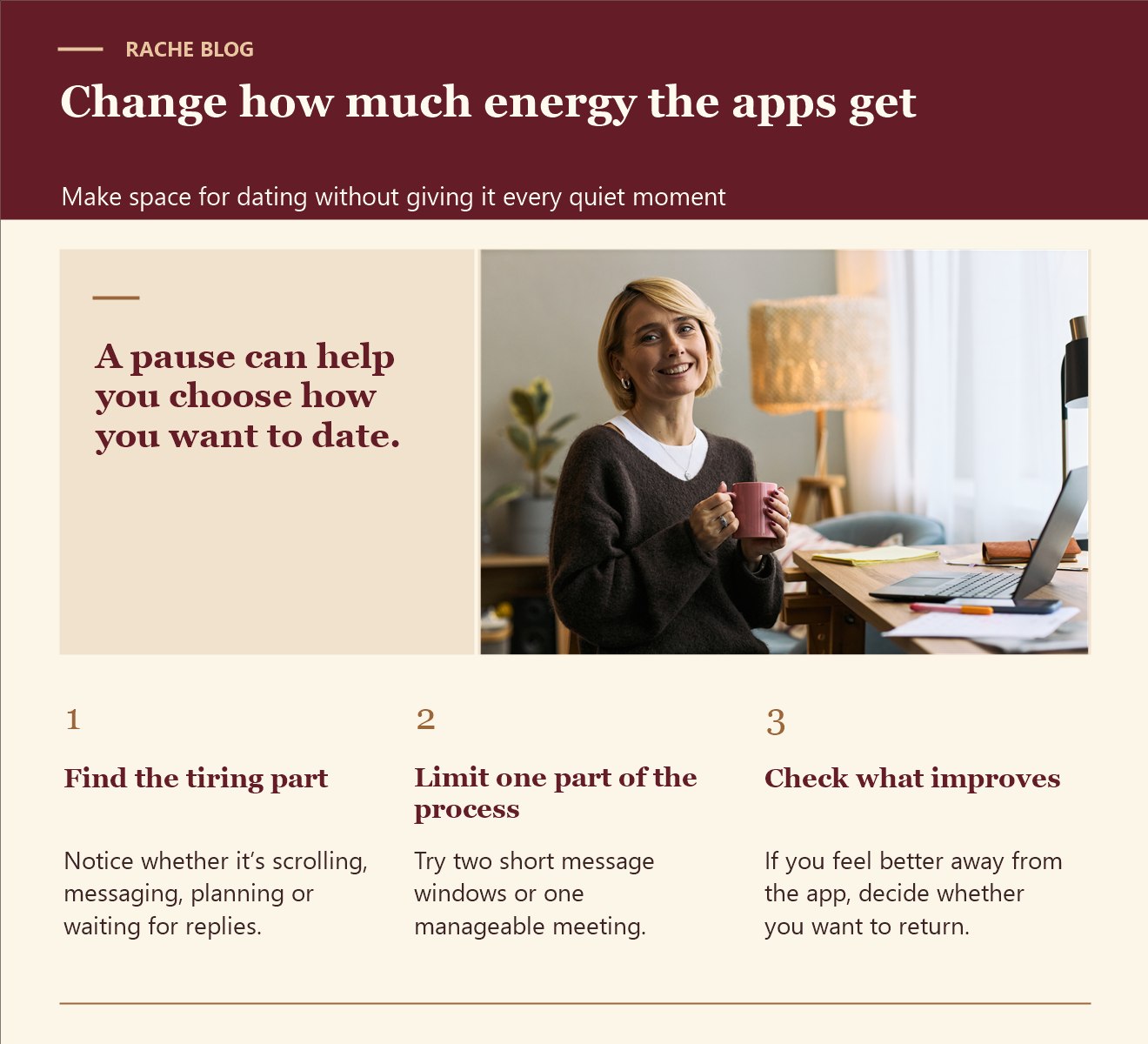
Change how much energy the apps get
Make space for dating without giving it every quiet moment
- Find the tiring part Notice whether it’s scrolling, messaging, planning or waiting for replies.
- Limit one part of the process Try two short message windows or one manageable meeting.
- Check what improves If you feel better away from the app, decide whether you want to return.
A pause can help you choose how you want to date.