

A dating profile can help people understand what matters to you before starting a conversation. Thinking of it only as a “funnel,” however, can turn dating into an exercise in attracting and ranking people instead of discovering whether you want to know each other.
You can be clear about your preferences without creating an ideal performance or a test of someone’s education, income or cultural tastes. Use the space to describe your intentions and ordinary life, while leaving room for another person to decide what fits them too.
On this page
1. Name the connection you are open to
Start with the relationship you would currently like to explore. “I would like a long-term partnership, with time to get to know each other” communicates more than a list of admirable traits.
If you want casual or nonexclusive dating, say so in language you are willing to discuss. Do not present a long-term intention simply because you think it will attract more replies.
You do not need to publish your entire relationship history. Give enough information to avoid a misleading first impression, and revisit the conversation when circumstances or intentions change.

2. Show what a value looks like in ordinary life
Words such as “kind,” “curious” or “family-minded” can mean different things. Add a small example that explains your meaning: “I value making time for the people close to me, even when the week is busy.”
For curiosity, you might write, “I enjoy asking how things work and hearing why someone loves a hobby I know little about.” There is no need to choose the most unusual activity or impressive achievement.
Use your own examples. A detail is useful because it is true and understandable, not because it proves that you belong to a more desirable group.
3. Separate important needs from flexible preferences
Some questions may strongly affect compatibility, such as whether you want children, the relationship structure you want or the time you can realistically spend together. Other preferences, such as favourite authors or weekend breakfasts, may be flexible.
Consider which matters need a clear early conversation and which you would enjoy discovering gradually. You can state an important preference respectfully: “I do not want children, and I am looking for someone who wants a similar future.”
A different preference does not make someone inferior. It may simply mean that the relationship each of you wants would not fit.
4. Avoid making the profile a hidden test
A quotation, mathematical reference or specialist hobby can be part of your profile if it genuinely interests you. It cannot reliably establish a reader’s intelligence, education or ability to be a caring partner.
Instead of expecting someone to recognise a reference, give them a way into the conversation: “I am learning about astronomy and still get excited when I can identify a planet. What have you enjoyed learning recently?”
Likewise, do not invent adventurous hobbies or expensive habits to attract a particular kind of person. You should not have to maintain a fictional life when a conversation moves beyond the app.
5. Build a short introduction from three true details
Try combining an ordinary interest, a value and an intention. For example: “Most weekends include a long walk and an attempt at a new recipe. I value reliability and a good conversation. I would like to meet someone who is open to a steady relationship.”
This is a template to adapt, not a promise that particular words will bring the right match. Replace each detail with something that sounds natural when you say it aloud.
Keep private information out, including your address and exact schedule. If practical photo and account choices are still unfinished, use the setup guide below.
6. Let the conversation add what a profile cannot
A profile is an introduction, not a full account of someone’s character. Ask questions, listen to the answers and notice how you both handle plans, differences and boundaries as you get to know each other.
The love is respect guide to boundaries applies respect for personal limits to casual, new and established relationships. Clear wording in a profile does not replace those ongoing conversations.
You can change your mind, and so can the other person. Fewer replies do not necessarily mean that an honest preference was a mistake; more replies do not establish compatibility. Consider whether the conversations feel relevant, respectful and worth continuing.
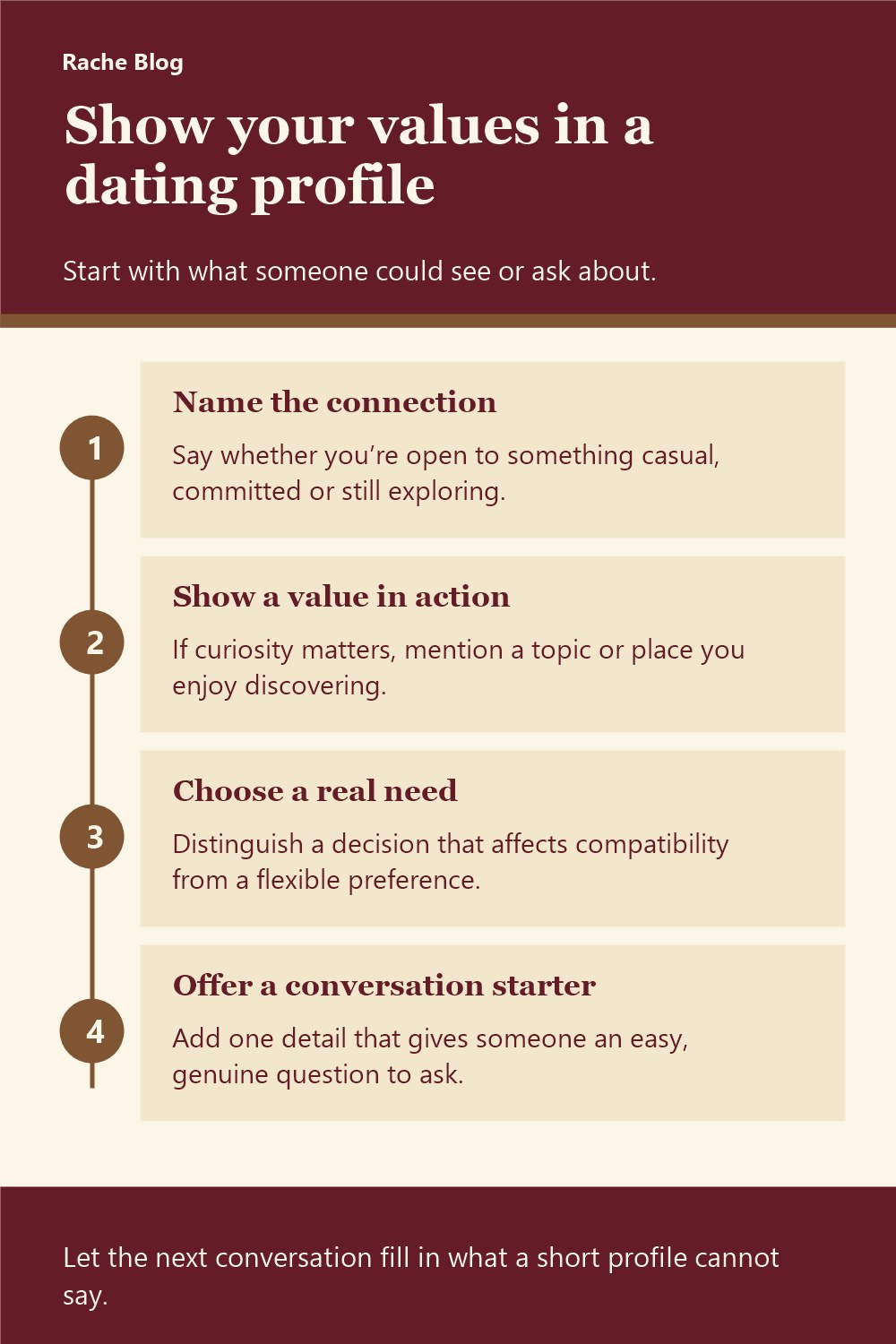
Read the infographic in text
Show your values in a dating profile Start with what someone could see or ask about.
- Name the connection Say whether you’re open to something casual, committed or still exploring.
- Show a value in action If curiosity matters, mention a topic or place you enjoy discovering.
- Choose a real need Distinguish a decision that affects compatibility from a flexible preference.
- Offer a conversation starter Add one detail that gives someone an easy, genuine question to ask.
Let the next conversation fill in what a short profile cannot say.