

Starting online dating can bring practical questions: what to put in a profile, how much to share and when to meet. You can take one step at a time and change your mind along the way.
These eight considerations can help you prepare without treating every match as a promise or every unanswered message as a verdict about you.
On this page
- Treat profiles and match scores as starting points
- Let your profile show real interests
- Protect privacy while checking what you can
- Set boundaries for unwanted contact
- Ask about intentions instead of assuming
- Choose a service and pace you can manage
- Leave room for your own choices
- Plan a first meeting you can leave
Treat profiles and match scores as starting points
A questionnaire or profile gives you selected information about someone. It cannot tell you everything about how you would communicate, spend time together or handle a disagreement.
Use an answer to begin a conversation when it matters to you: “You said you would like children. Is that something you are hoping for?” A different preference about an important life choice deserves attention, while a different favourite film may simply give you something to ask about.

Let your profile show real interests
Choose photos and details that represent you now. You can enjoy a mixture of hobbies without making yourself fit one neat category or trying to appeal to everyone.
A specific sentence gives someone more to respond to: “I like finding small museums and making Sunday lunch” says more than a list of ideal qualities. Keep other people out of your profile photos unless they are comfortable being included, and avoid details that reveal a private routine or location.
Protect privacy while checking what you can
Consider what a stranger can learn from your profile and linked accounts. Keep your home address, financial details and other sensitive information private, and review location-sharing settings.
Peel Regional Police’s online-safety guidance includes limiting personal information and planning a public first meeting with your own transport. You can look at publicly available details without accessing private accounts. A convincing photo or conversation does not establish that every claim is true.
Set boundaries for unwanted contact
You may encounter a mismatch or an unanswered message. Harassment, threats and sexual pressure do not become acceptable parts of dating that you must learn to tolerate.
You can stop a conversation, decline a request or use the service’s available report and block controls. If someone threatens or repeatedly contacts you, consider support from someone you trust and the relevant platform. Responsibility for that behaviour belongs to the person doing it, not to you for having created a profile.
Ask about intentions instead of assuming
People may be looking for different kinds of connection. State what you would like without promising a future to someone you have just met: “I am interested in an ongoing relationship, while taking time to get to know someone.”
Ask what the other person is seeking and hear the answer. You do not need to persuade a person who wants something different, and you can revisit the conversation if your own preferences change.
Choose a service and pace you can manage
Before joining, read what the service explains about privacy, messaging and reporting unwanted behaviour. Consider whether you understand the arrangement you are accepting and whether it suits the time you want to spend.
You do not need to try a set number of services. You can begin with one, adjust how often you use it, take a break or decide that meeting people elsewhere suits you better. Our guide to making online-dating choices more manageable explores setting a browsing pace.
Leave room for your own choices
You can be open about meeting someone online, keep the early stages private or decide that online dating is not for you. There is no need to defend the origin of a relationship to everyone who has an opinion.
Try noticing what you enjoy and what drains you. You may like a particular conversation without wanting a date, or enjoy a date without wanting another one. Neither decision requires you to dismiss the other person or criticise yourself.
Plan a first meeting you can leave
If you choose to meet, consider a busy public place, a manageable length and your own way home. Let someone you trust know your plans if that is safe for you, and keep access to a charged phone.
These choices can support your options; they cannot guarantee safety. You can leave when you want to, seek help if you feel unsafe and decline pressure to move somewhere private. Afterwards, give yourself room to decide whether you would like to meet again.
Review three settings before you start messaging
Take a moment to see how the app displays your location, whether it shows a workplace or account link, and which alerts appear on your lock screen. If a feature feels unclear, leave it off or check the app’s help page before sharing more.
If a profile asks you to move off the app immediately, you can keep the conversation where it is. The Tech Safety Canada guide to dating privacy explains choices about location, photos and device settings.
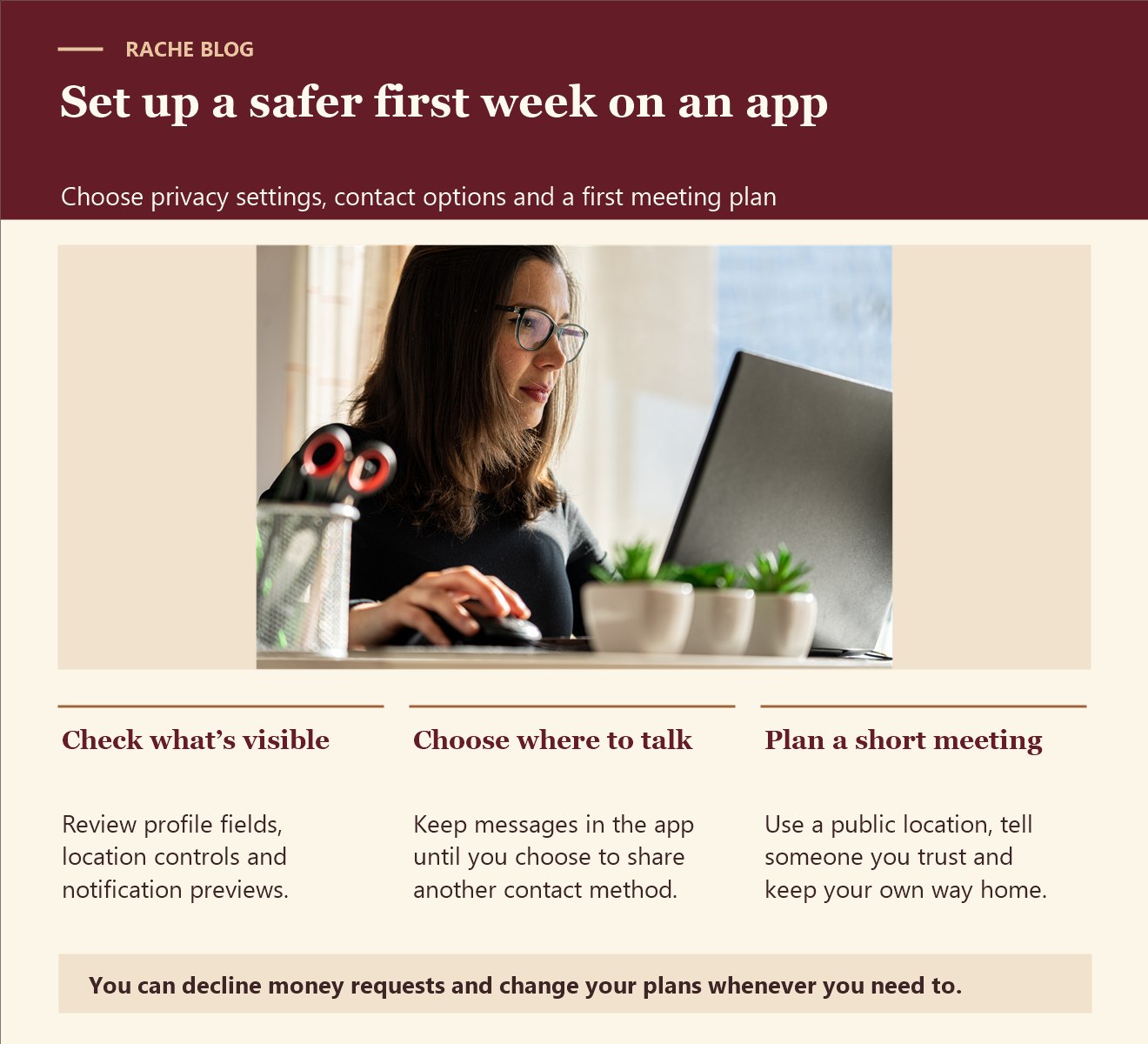
Read the infographic in text
Set up a safer first week on an app
Choose privacy settings, contact options and a first meeting plan
- Check what’s visible Review profile fields, location controls and notification previews.
- Choose where to talk Keep messages in the app until you choose to share another contact method.
- Plan a short meeting Use a public location, tell someone you trust and keep your own way home.
You can decline money requests and change your plans whenever you need to.
Frequently asked questions
1. Can I hide my exact location on a dating app?
Check the app’s settings and help page to see what it displays. Device permissions control access to your location, and the app can have a separate option for whether it shows a distance or location to others.
2. What should I leave out of my profile photos?
Look for your home address, a workplace badge, a child’s school name, or other details you want to keep private. Use a recent recognizable photo with a simpler background if you notice any of those details.
3. What if a match wants my phone number immediately?
You can stay in the app and say that is where you prefer to talk while getting acquainted. Use the app’s block or report option if the person pressures you or ignores the request.
4. How can I make it easier to leave a first date?
Choose a public place, set a short meeting time and arrange your own transport. Tell someone you trust where you are meeting and when you plan to check in.
5. Can I change my mind after I’ve agreed to meet?
Yes. You can reschedule, cancel or end the conversation. If someone threatens or harasses you, consider using the app’s reporting options and asking a trusted person or local support service for help.