

When a relationship feels “fake,” it helps to name the actual concern. Do you feel misled, unheard, disconnected or unsure what you have agreed to?
A casual or mainly sexual relationship is not automatically dishonest. The more useful questions are whether both people understand the arrangement, choose it freely and treat each other with respect.
On this page
Name what feels missing
Instead of asking whether your relationship passes a test of depth, consider what you want more of. That might be shared time, affection, conversation, reliability or a clearer agreement about exclusivity.
Try describing a situation rather than assigning an intention: “We meet late at night, and I would like to spend time together during the day too.” That gives the other person something specific to answer. “You are only pretending to care” asks them to defend against a conclusion you cannot establish from a schedule alone.
You can want a different kind of relationship even when nobody has broken an agreement. Naming that difference is more useful than calling one kind of connection inferior.
Do not use arguments as a test
The number of arguments you have cannot prove whether your relationship is genuine. Some people discuss differences quietly; others may be avoiding a difficult subject. You need to look at how a particular conversation works.
Can you disagree without being threatened or humiliated? Can both people explain what matters and have their answer taken seriously? If a problem is raised, can you discuss a practical response?
The National Domestic Violence Hotline’s relationship guide highlights communication, respect, equality and boundaries. You do not need to create conflict to demonstrate intimacy, and repeated harmful arguments do not become healthy because they feel intense.

Talk about attention and time together
If phones interrupt a date, ask about the situation before deciding what it means. Someone may be dealing with work, caregiving, accessibility needs or a habit they have not considered. A screen does not reveal their feelings for you.
You could say, “I would like some time when we can talk without checking messages. Would the first half-hour of dinner work, allowing for anything urgent?” Agree on something realistic for both people.
Then notice whether your concern can be discussed and whether an agreement is respected. Our guide to digital boundaries for couples offers examples involving attention, photos, accounts and privacy.
Ask what you are both choosing
It can be uncomfortable to ask directly, but guessing may leave each of you working with a different understanding. Pick a time when you can talk without making the conversation a demand for immediate commitment.
- “What kind of relationship are you interested in now?”
- “Are we agreeing to date exclusively, or is that still undecided?”
- “How much time together would feel realistic for you?”
- “I want an ongoing partnership. Is that something you also want?”
These are examples to adapt. Hear the answer as it is, including uncertainty or a different preference. Shared affection does not automatically create the same expectations about a future.
Look for reliable agreements
Knowing someone’s favourite food is pleasant, but it is not a measure of whether you truly know them. Consider whether you can learn about each other’s values, preferences and limits at a pace you both choose.
Deep closeness does not require immediate access to every secret, password or painful memory. Respecting privacy can be part of getting to know someone. Notice whether interest goes both ways and whether you can decline a question without punishment.
Look at actions alongside words: following through on plans, acknowledging a missed agreement and making room for an honest answer. A romantic label cannot replace those ordinary forms of consideration.
Decide what works for you
You may both enjoy a limited or casual connection, want to build something different, or discover that your preferences do not fit. None of those outcomes can be settled by one person deciding that the other should want more.
If you agree to try a change, make it specific enough to discuss later. If the arrangement leaves you repeatedly unhappy, you can step back without proving that the relationship was fake.
You do not owe sex, personal information or a longer commitment to make someone feel reassured. When pressure, fear or control is affecting your choices, private support may be more useful than another attempt to persuade your partner to understand.
Read the infographic in text
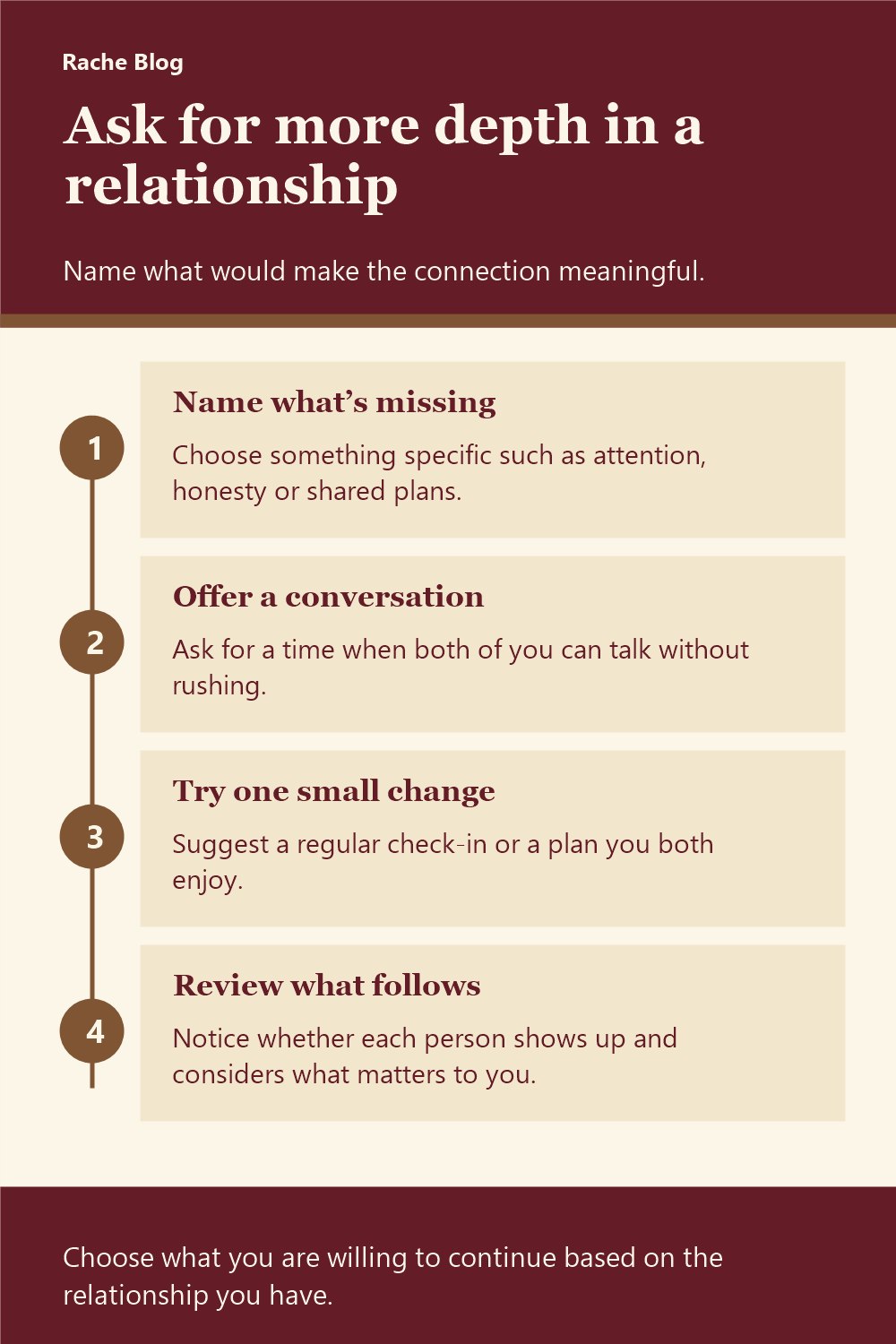
Ask for more depth in a relationship Name what would make the connection meaningful.
- Name what’s missing Choose something specific such as attention, honesty or shared plans.
- Offer a conversation Ask for a time when both of you can talk without rushing.
- Try one small change Suggest a regular check-in or a plan you both enjoy.
- Review what follows Notice whether each person shows up and considers what matters to you.
Choose what you are willing to continue based on the relationship you have.