

Long-distance texting can make room for small moments you would otherwise miss: a kind thought, an ordinary update or a plan to talk later. The aim is a connection both people can enjoy, with room for lives beyond the phone.
There is no message schedule that guarantees a lasting relationship. Start with what helps each of you feel connected, then agree on a rhythm you can realistically maintain.
On this page
Agree on a rhythm that fits real life
Discuss time zones, work, sleep, caregiving and how each of you uses your phone. One person might enjoy brief daily messages; another might prefer fewer texts and a longer scheduled conversation. Neither preference automatically measures how much someone cares.
Make the agreement specific enough to try: “Let’s send an update when we can and set aside Saturday morning for a call.” A good-morning or goodnight text can be affectionate if you both enjoy it. It need not become an attendance check or a rule that makes a busy day feel like a relationship offence.

Try messages with a clear purpose
Use these examples as starting points, changing the words to sound like you:
- Share an ordinary moment: “I passed that bakery we liked and thought of our afternoon there.”
- Invite an update: “How did your presentation go? Reply when you have a quiet moment.”
- Offer encouragement: “I know today matters to you. I’m thinking of you.”
- Check what support would help: “Would you like to talk it through, have a distraction or get some space?”
- Make a plan: “Would a call at seven your time work tomorrow?”
- Share something light: “This made me laugh—thought you might enjoy it too.”
- Express affection: “I miss spending time with you. I’m glad we made time to talk yesterday.”
- Explain your availability: “I’m putting my phone away for the evening. I’ll check in tomorrow.”
Send a message because it expresses something you mean, rather than using a script to produce a particular response. Leave room for your partner to answer in their own words and at an agreed pace.
Agree on privacy and photo boundaries
A photo of your walk, a meal or a shared hobby can invite someone into your day. Check before sharing images of other people or information that reveals private details. Ask before forwarding your partner’s messages, posting about the relationship or sharing a photo they sent privately.
Intimate pictures are never a requirement for proving love or maintaining interest. Once an image has been sent, you cannot be certain how it will be stored or shared. Love is respect’s digital-boundaries guide explains why privacy, communication expectations and the freedom to decline need explicit discussion.
Our guide to digital boundaries for couples has further questions about phones, photos and privacy.
Discuss delayed replies without mind-reading
A read receipt, short answer or gap between messages cannot tell you everything about someone’s feelings. If the pattern is troubling you, describe what you have noticed and ask for a conversation: “We have missed our last two planned calls. Is this still a schedule you can manage?”
Explain the effect on you without requiring constant access. You might agree on a brief update when plans change or choose a different time to connect. If your needs remain different, consider whether the arrangement works for both of you.
A conversation about reliability is different from demanding passwords, location updates or photographs as proof of where someone is. If monitoring, threats or pressure are involved, seek support through a safe route rather than treating the problem as a texting technique to perfect.
Choose a format that helps you understand
Messages can be useful for affection, updates and making a plan. For a complicated disagreement, ask which format would help you both communicate: a voice call, video, text or time to write a considered response. Accessibility, privacy and comfort may make different choices work for different people.
If the exchange is becoming confusing, try: “I don’t think we are understanding each other here. Can we choose a time and a format to talk this through?” Agree on when to return to it so a pause does not leave the issue hanging indefinitely.
Review the agreement as life changes
Check whether the current pattern still feels manageable. Are both people initiating sometimes? Are planned conversations happening? Can either of you request a change without being punished for needing time offline?
Texting can support a relationship, but practical questions still need discussion: visits you can afford, time together, shared expectations and whether your future plans fit. A thoughtful message can open that conversation; it cannot decide the answers for you.
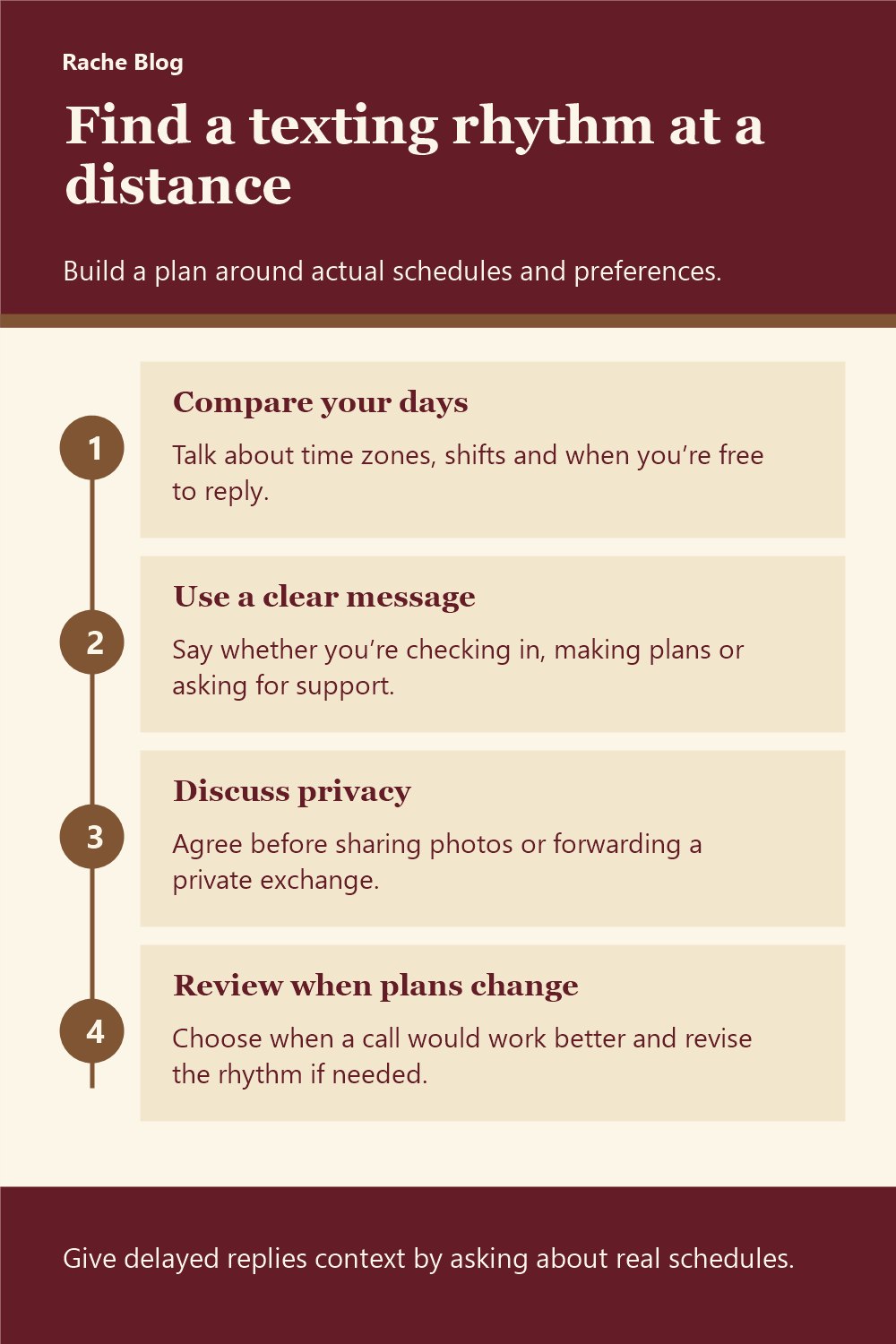
Read the infographic in text
Find a texting rhythm at a distance Build a plan around actual schedules and preferences.
- Compare your days Talk about time zones, shifts and when you’re free to reply.
- Use a clear message Say whether you’re checking in, making plans or asking for support.
- Discuss privacy Agree before sharing photos or forwarding a private exchange.
- Review when plans change Choose when a call would work better and revise the rhythm if needed.
Give delayed replies context by asking about real schedules.