

Taking turns choosing a film or keeping a list of household tasks can be useful. A record can make an uneven workload easier to see. The problem is different when every favour becomes a debt, a practical request turns into a contest or someone is told to forget an unresolved hurt to prove their love.
You can look for fairness without putting a price on every act of care. Start by separating the work that needs sharing, the agreements that need following through and the past events that still need attention.
On this page
1. Describe one concern before debating who does more
“I do everything” may express real exhaustion, but it can leave the next action unclear. Name the part that has become difficult: “I arrange the meals, buy the food and clean up most evenings. I need us to share more of that work.”
Ask how the other person sees the situation too. There may be work happening outside your view, or a responsibility one of you thought had already been shared. Listening does not require dismissing what you have noticed.
Separate different concerns. Wanting acknowledgement is not exactly the same as needing a task reassigned. An apology for a broken promise will not finish the laundry, and taking out the rubbish will not necessarily resolve the broken promise. Naming each issue gives you something more specific to discuss.

2. Include the planning as well as the visible task
A job can involve noticing that it needs doing, deciding what is required, arranging it, carrying it out and checking that it is finished. If one person still has to prompt every step, they may remain responsible for much of the work.
For example, taking responsibility for groceries might include checking supplies, making the list, arranging transport or delivery and putting the food away. Agree on what the task includes rather than assuming that one visible step covers everything.
Consider paid work, travel, household work, care, appointments and the time each person has to rest. Not every couple shares a home or has children, so use the responsibilities that actually belong to your relationship.
Cornell Cooperative Extension’s work-and-family guide suggests reviewing time spent across different responsibilities when considering a fairer division. A brief written overview can support that conversation. It does not have to become a permanent ranking of each person’s value.
3. Discuss what a fair arrangement means now
Counting the same number of tasks does not tell you whether the load is manageable. Tasks vary in frequency, time, effort and how easily they can be postponed. One weekly job and several daily jobs may ask very different things of someone.
Capacity matters too. Work shifts, disability, illness and caring responsibilities can change what each person can do. An uneven division may be something you both choose for a period of time. Keep discussing the support and rest each person needs rather than assuming the arrangement must continue indefinitely.
Experience and preference can help you divide work, but “you are better at it” should not automatically settle every assignment. Consider whether someone could learn a task, whether the standard needs discussing or whether a less demanding approach would meet the need.
Fairness can also mean having room to choose. You do not both have to attend every errand or social event. Where a decision affects shared responsibilities, discuss how those responsibilities will still be covered.
4. Make an agreement specific enough to review
Choose one responsibility to begin with. A useful agreement can cover:
- The job: what needs doing, including the planning and follow-up.
- The owner: who will take responsibility without routine reminders.
- The timing: when it needs to happen and what counts as finished.
- The backup: how you will communicate and adjust if circumstances change.
For example: “I will arrange the weekly shop, including the list, on Thursday. If I cannot do it, I will tell you in time for us to decide another plan.” This is more concrete than promising to help more whenever asked.
Leave room for different ways of completing a task, while discussing requirements that matter to both of you. Taking ownership does not mean ignoring an agreed deadline or expecting the other person to quietly redo the work.
Choose a manageable time to check how the arrangement worked. Look at what actually happened, what got in the way and what should change. Our guide to relationship expectations and practical agreements can help you make the request clearer.
5. Give unresolved hurt its own attention
Remembering a past event is not automatically unhealthy scorekeeping. An issue may return because it was never acknowledged, because an agreement was broken again or because its effects are still present.
At the same time, an unrelated grievance does not create a useful answer to every practical request. If two concerns are competing for attention, name both and consider how to discuss each. “I want us to sort out this week’s responsibilities, and I also want to return to the promise that was broken.”
Repair may involve acknowledging what happened, considering its effect and changing the relevant behaviour. Forgiveness is a personal choice; it is not an instruction to erase your memory, stop asking for accountability or restore trust immediately.
Trust can be reviewed through conduct over time. You can care about someone and still keep a limit, seek support or decide that an arrangement no longer works for you.
6. Let appreciation sit alongside changed behaviour
A specific thank-you can recognise effort: “I appreciated not having to organise that appointment.” Offer it when it reflects what you feel. You do not have to generate gratitude on demand or use it to talk yourself out of an unfair workload.
Acknowledgement and practical change can both matter. A compliment does not replace an agreement being carried out, and asking for a different arrangement does not cancel the good things you value.
If raising a concern repeatedly leads to mockery, threats or control, take that pattern seriously. A task chart cannot make coercion safe. Seek private individual support if you are worried about the response to a conversation or a change in arrangements.
Choose one next step you can assess: make the workload visible, agree on a complete responsibility or return to a specific unresolved issue. Then consider whether the response and follow-through give both people a workable place in the relationship.
Include the work that happens before a chore
If one person says they handle the groceries, ask what that includes. The other person may still plan meals, check what’s missing and remember when to shop. Write down the pieces and decide who can own the whole task on a trial week.
After trying it, compare whether both people had time to rest and whether someone still had to prompt each step. Adjust the plan if care, work or health responsibilities changed. Allison Daminger’s study of household labor explains how noticing a need and checking what happened are part of the work.
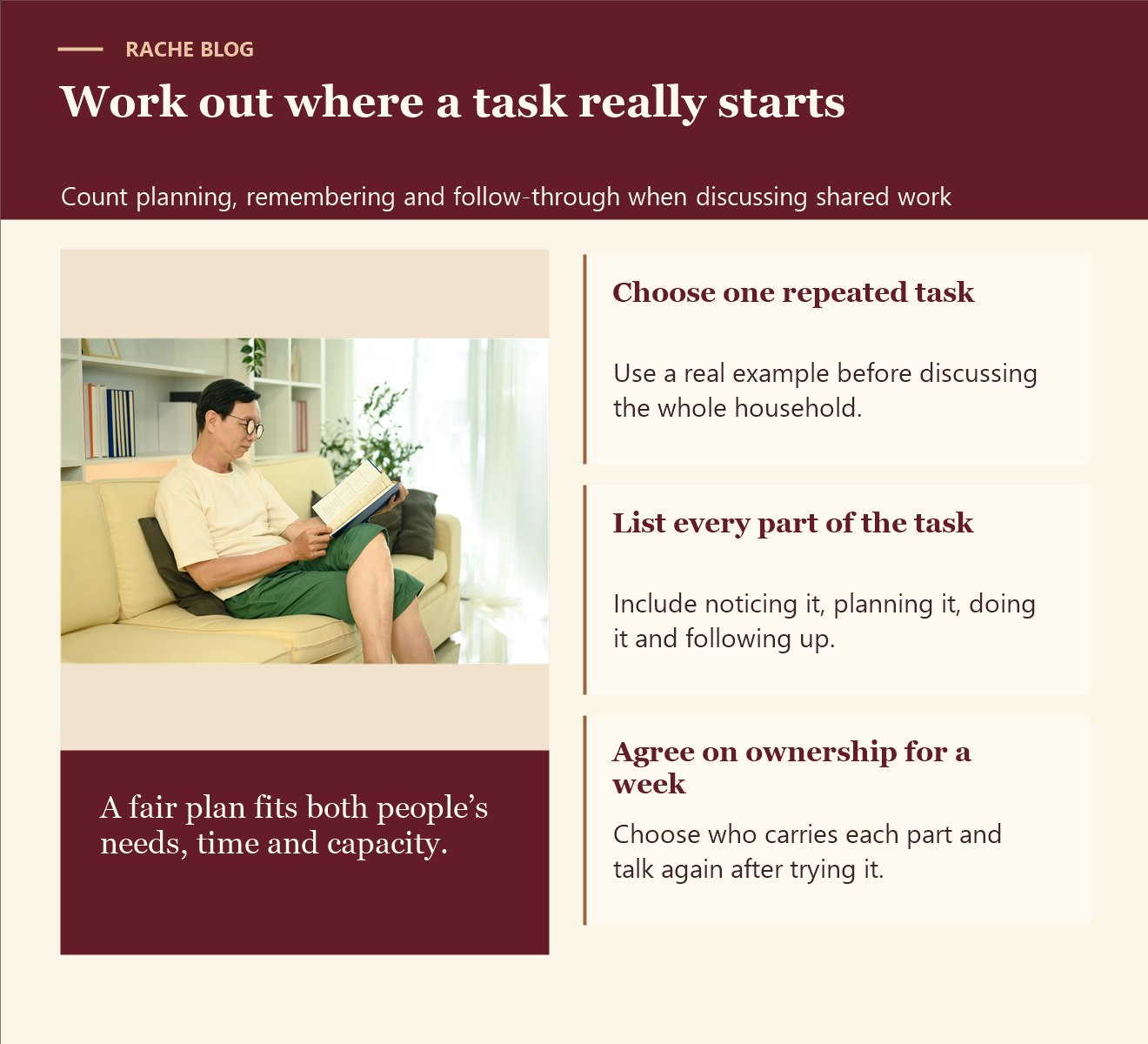
Read the infographic in text
Work out where a task really starts
Count planning, remembering and follow-through when discussing shared work
- Choose one repeated task Use a real example before discussing the whole household.
- List every part of the task Include noticing it, planning it, doing it and following up.
- Agree on ownership for a week Choose who carries each part and talk again after trying it.
A fair plan fits both people’s needs, time and capacity.