

A relationship’s future cannot be read from a single disagreement, a quiet week or a checklist. You can make a more informed choice by looking at current behaviour, the plans you each want and whether you can discuss differences without fear.
Use these questions to identify what needs a conversation or a practical decision. You do not have to prove that a relationship is certain to fail before deciding that you no longer want it, and you do not need to make a permanent decision during every difficult moment.
On this page
- Can you be yourself without being belittled or controlled?
- Are you choosing the person who is here now?
- What happens when everyday life becomes difficult?
- Can you discuss support without expecting unlimited availability?
- Do your plans describe lives you both want?
- How is the work of the relationship shared?
- Does trust allow both closeness and privacy?
- What decision or conversation would help you now?
1. Can you be yourself without being belittled or controlled?
Consider how your partner responds to your interests, friendships, appearance and ordinary choices. A difference in taste is not the same as repeated humiliation, threats or rules about who you can see. Describe actual examples rather than trying to decide whether you are simply too sensitive.
Respect does not mean agreeing with every choice. It includes being able to disagree without insults or intimidation. If you are afraid of the response to an ordinary boundary, seek support rather than relying on a better argument to make the situation safe.
2. Are you choosing the person who is here now?
Ask whether you want the relationship as it currently exists, including the differences that may remain. Hope for change is not the same as a freely agreed plan, and care for someone does not obligate you to accept every behaviour.
Separate a preference from a boundary. Different hobbies may be easy to live with; incompatible decisions about children or commitment may need more serious consideration. Avoid promising yourself that you can reshape the other person into the partner you want.

3. What happens when everyday life becomes difficult?
A stressful day can affect patience. Look at what happens across situations: can you pause a conversation, return to it and take responsibility for hurtful behaviour? Occasional irritation does not provide a complete forecast, but repeated contempt should not be dismissed as normal stress.
Notice what repair actually involves. An apology can matter, and so can the actions that follow it. Choose one recent disagreement and consider whether both people had a chance to speak and whether anything changed afterward.
4. Can you discuss support without expecting unlimited availability?
Partners can offer care without being able to meet every need at every moment. Talk about what support means to you: listening, practical help, affection, a check-in or time alone. Ask what is realistic when work, illness or other responsibilities limit someone’s capacity.
For example, “Could we talk for twenty minutes after dinner?” is clearer than expecting someone to know that you need comfort. At the same time, repeatedly dismissing every request deserves attention. Consider the pattern rather than treating one unavailable evening as the answer.
5. Do your plans describe lives you both want?
Discuss the decisions that matter to you: where to live, whether to marry, children, work, money and time with family. Ask about actual preferences rather than assuming that more time together will produce the same goals.
You may find flexible arrangements, or you may identify a difference neither person wants to change. Avoid treating reluctant agreement as a settled solution. It is possible to care about each other and still want futures that are difficult to combine.
6. How is the work of the relationship shared?
List the work you are discussing, such as organising time together, managing household tasks or returning to unresolved conversations. Fairness does not always mean identical tasks or equal effort every day, but one person should not be expected to carry everything indefinitely.
Ask for a specific adjustment and notice whether it happens. An agreement about who will arrange the next visit is more useful to review than a general promise to try harder. Your observations can inform your choices without becoming a score used to punish each other.
7. Does trust allow both closeness and privacy?
Trust involves how people handle agreements, honesty and accountability. It does not require constant access to passwords, messages or location. If an agreement has been broken, discuss what happened and what each person would need in order to consider continuing.
Avoid using surveillance as a substitute for a decision about the relationship. Love is respect’s boundaries guide distinguishes protecting your needs from controlling someone else. You can decide what you will participate in without demanding control of another person’s private life.
8. What decision or conversation would help you now?
You might arrange a focused conversation, seek practical information, ask for outside support or decide to leave. Choose the next step that fits the issue you have identified. You do not need to answer every question about the rest of your life in one sitting.
If you want to continue, agree on something concrete to revisit rather than a guarantee that everything will improve. If you want to end the relationship, prepare clear words and any shared arrangements that need attention. When threats or control are involved, put support and safety ahead of a joint discussion.
Read the infographic in text
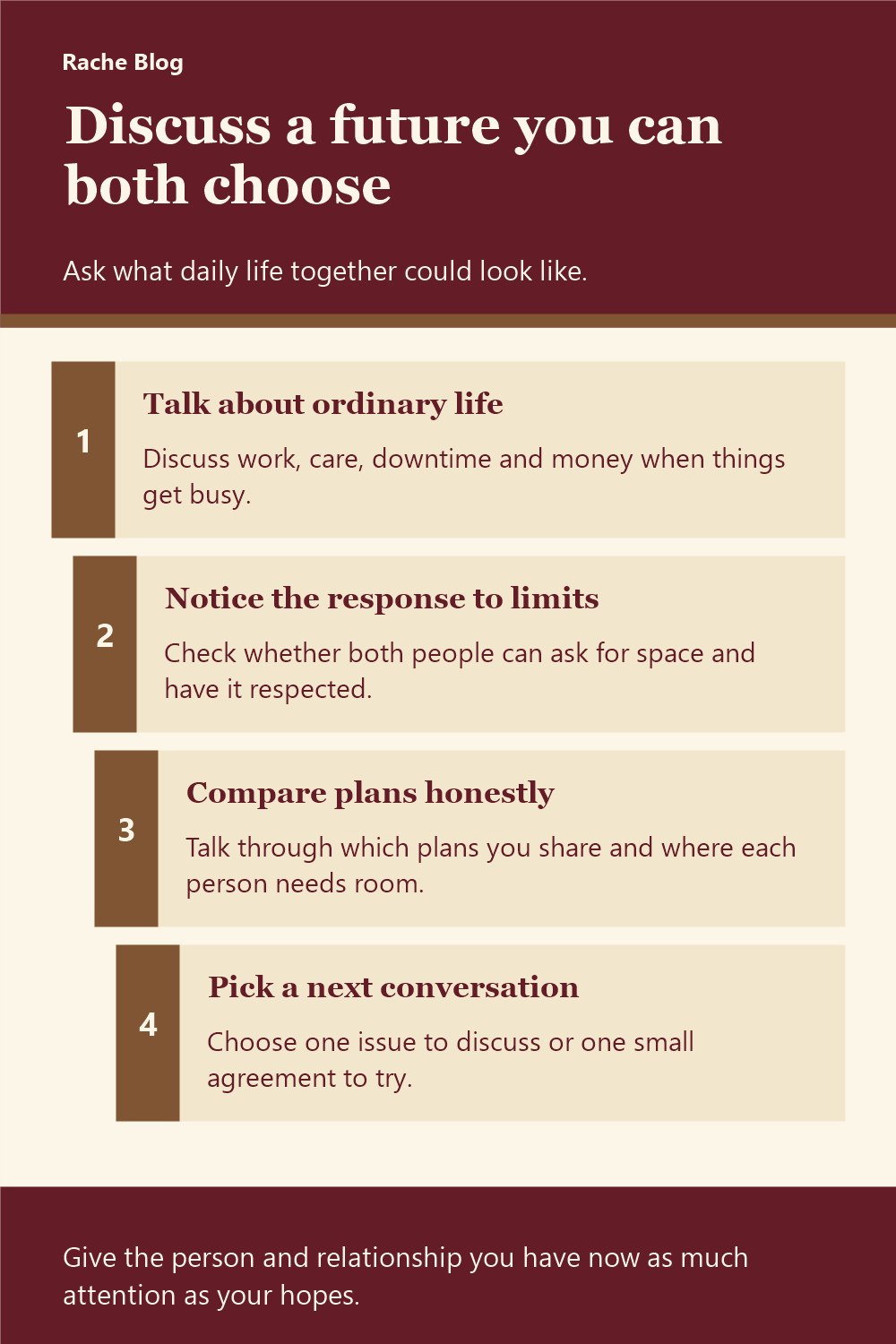
Discuss a future you can both choose Ask what daily life together could look like.
- Talk about ordinary life Discuss work, care, downtime and money when things get busy.
- Notice the response to limits Check whether both people can ask for space and have it respected.
- Compare plans honestly Talk through which plans you share and where each person needs room.
- Pick a next conversation Choose one issue to discuss or one small agreement to try.
Give the person and relationship you have now as much attention as your hopes.